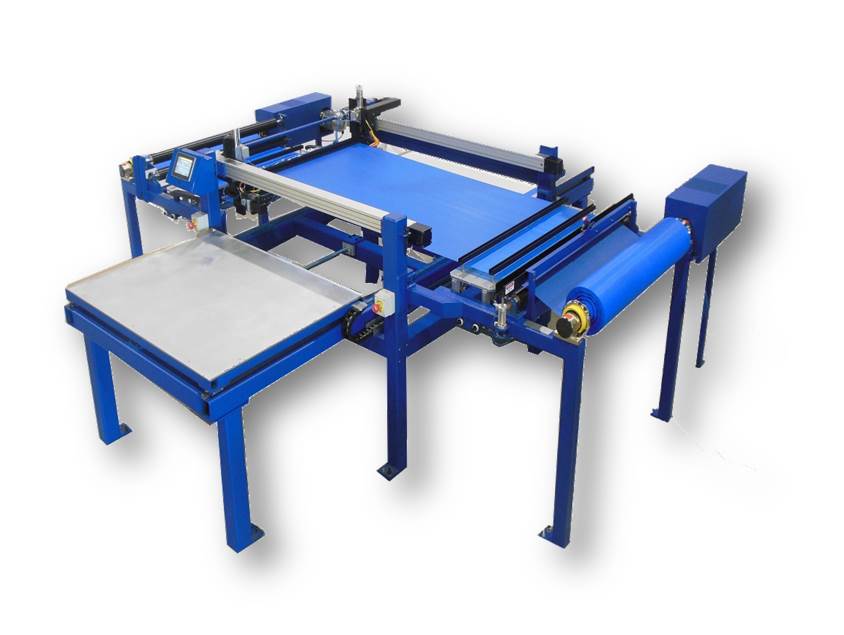
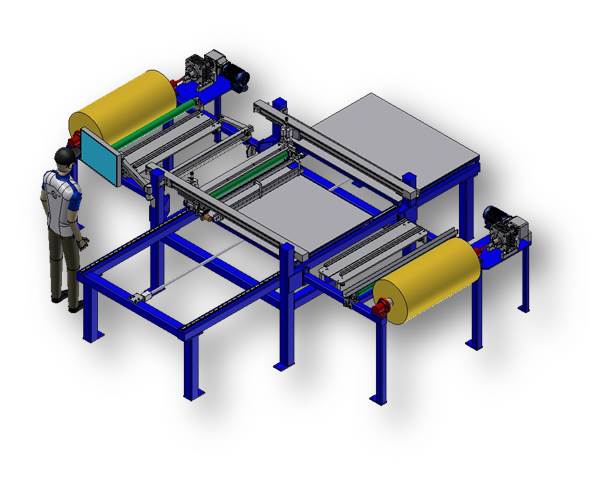
Flat Charge Laminator
Features:
- Forms 12" wide laminates up to 36 feet long
- Carriage holds 3 different rolls of thermoset prepreg fabric and 2 film rolls, and moves 60 feet under closed loop servo control
- Material heads individually control position, web tension, transverse cutting, and heating to ensure tack
- Stylus cutter slices the unidirectional tape without cutting through the backing paper
- Vacuum table is used to hold the laminate in place as it is being formed
- Laydown speeds of 100 feet/minute with edge alignment of ±0.010 inches and add/cut accuracy of ±0.030 inches
- Turret loading systens to automate material changeover
Situation:
Large commercial airplanes such as the Boeing 787 and A350 that are now utilizing composite fuselages also use composite stringers. As such, there are hundreds of stringers per aircraft and the need to make the stringers at a rate that matches the overall production rate of the fuselage is crucial to reducing total cost of manufacturing the entire structure. There are additional issues regarding scrap and final part quality which contribute to the cost of making the part manually.
Client is a Tier One manufacturer of primary structure aircraft parts supplied to an OEM aircraft manufacturer. In addition to furnishing a fully integrated fuselage the supplier must manufacture all of the stringers that are incorporated in the fuselage.
Problem:
In order to make required production rates the stringers must be manufactured using automation as hand layup cannot meet the required capacity.
Implication:
The capital cost and the speed by which the stringers can be made automatically on traditional ATP/AFP machines indicates significant unit cost overruns. Additionally, delivery of a traditional ATP/AFL machine cannot be made in time to support delivery requirements and there is limited physical space to install such a machine even if it were available. An alternate solution must be identified.
Solution:
A close examination of the part by Accudyne Systems yielded a machine design incorporating our novel “part purpose” approach, i.e. designing a machine optimized to make a single class of parts based on the specific part specification.